by tmt19 | Nov 20, 2025 | Dashboard, Team Project, Visualization
Launching La Table is more than opening a restaurant, it’s making a meaningful, long-term investment. With limited savings, choosing the wrong location would turn a dream into a risk. To avoid guessing, I turned to data.
The goal was simple: find a town in Lebanon where visitors (locals and tourists) already show strong interest, yet the restaurant market remains underserved.
Lebanon’s tourism and investment patterns often move in opposite directions. Some towns attract visitors but receive no development, while others receive projects despite having little demand.
For a new restaurant, this imbalance makes it difficult to know where genuine opportunity lies. I needed a location that is not saturated or speculative, but strategically overlooked.
Step 1: Scanning the Chaos for Opportunity – Lebanon as a whole
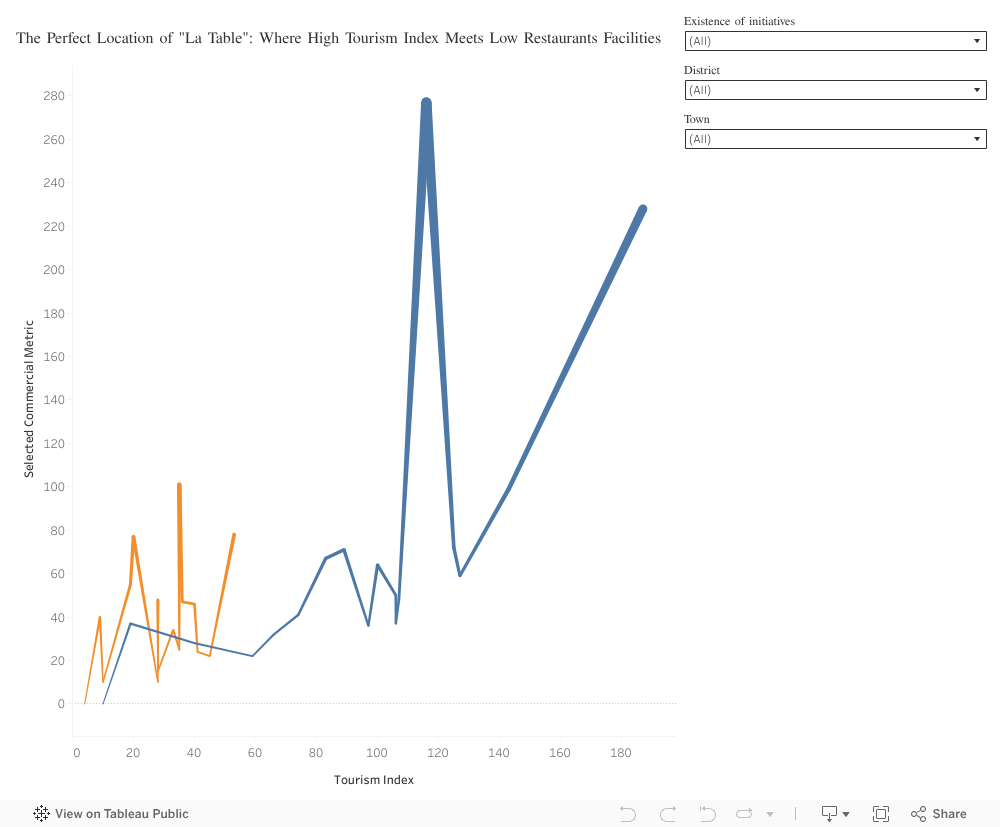
The national view shows two categories:
High-tourism towns with no initiatives (Blue): attractive but saturated with existing restaurants.
Funded towns with low tourism (Orange): received investments but struggle with attracting visitors.
We’re looking for a true blue diamond: a high-potential (human intuition), high-traffic location (tourism index), with unserved demand (number of restaurants, 0 project initiated).
Step 2: The first zoom – Targeting Zgharta
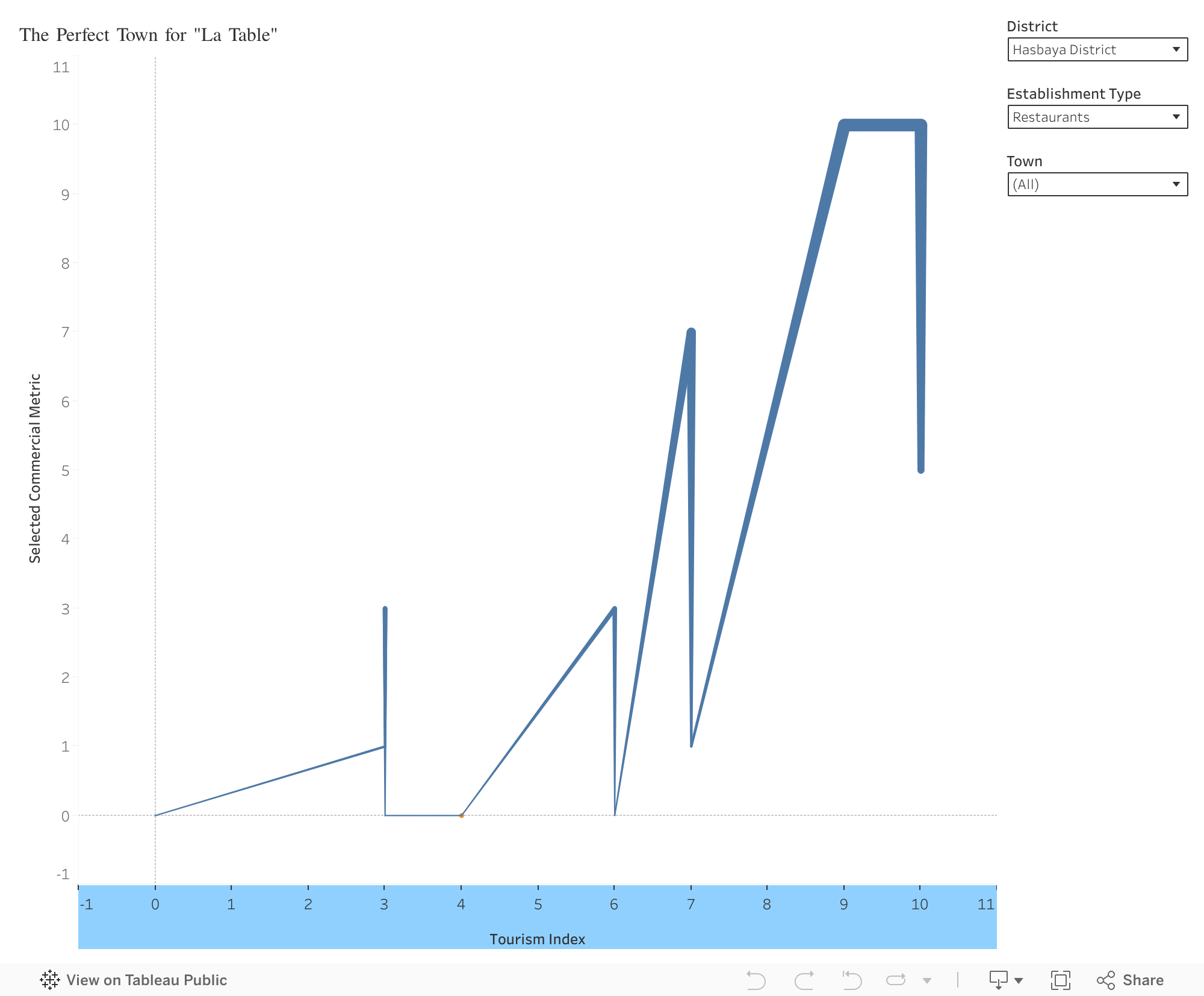
We must narrow the focus from the whole country to a high-potential region. We start by targeting the beautiful Zgharta District.
Safe option: a district away from saturation (low competition) yet rich in natural beauty and tourism interest (mid to high). It becomes the logical next step for deeper exploration.
(Action for Viewer: Please use the District filter and select Zgharta District.)
Step 3: The second zoom – Finding the Restaurant Gap
One town rises above the rest:
Beit Obeid, Zgharta District
- High tourism demand (index: 9).
- Low supply: few restaurants exist (1 restaurant), minimal competition.
- No recent initiatives, meaning the opportunity remains untouched.
Visitors are already coming, but the market has not responded. This is exactly the type of gap a new restaurant should fill.
In Beit Obeid, high demand, low competition, and authentic natural beauty come together, making it a place where La Table can truly belong and elevate the town’s charm. By moving from a national overview to a focused district analysis, the data revealed a location where potential and opportunity meet.
But beyond numbers, choosing Beit Obeid reflects vision, intuition, and respect for place.
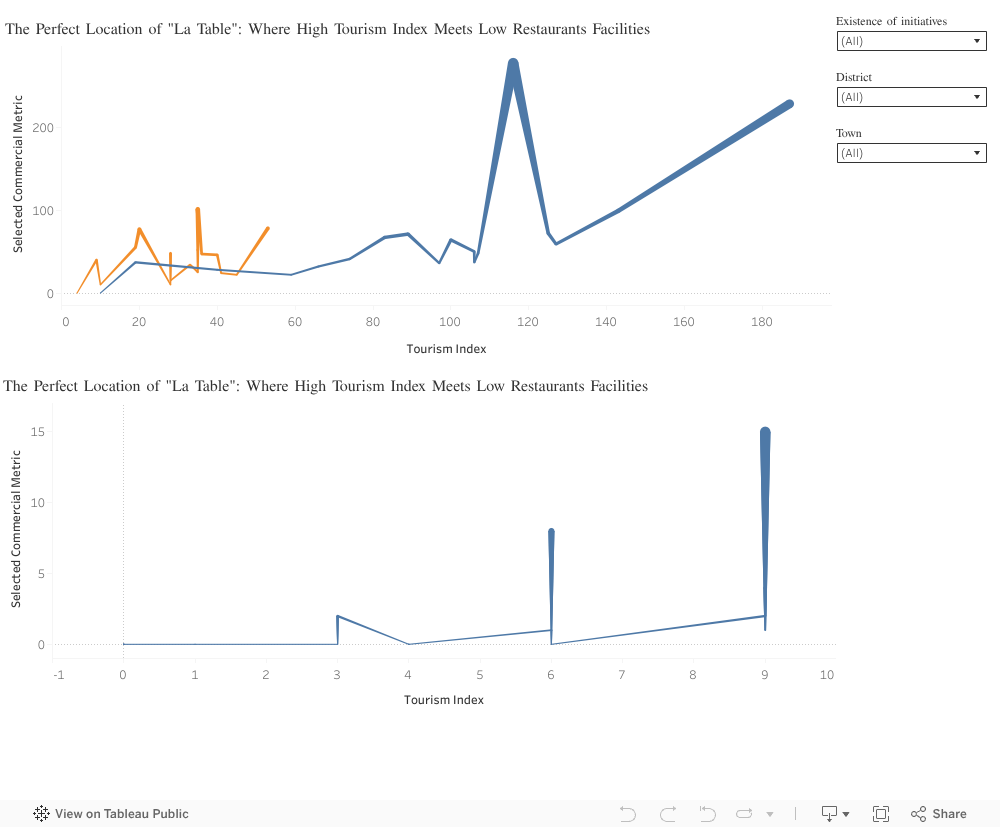
Overall view:

by egh13 | Nov 19, 2025 | Uncategorized
Introduction
Tourism in Lebanon is often celebrated for its beautiful landscapes, cultural heritage, and vibrant towns. But behind these well known attractions lie a more practical question: which towns are actually equipped to support tourism on a daily basis? To explore this, I created a dashboard comparing Lebanese towns based on the number of restaurants and cafes, the number of hotels, and an overall Tourism Score that ranks towns according to their tourism readiness. Instead of relying on impressions or reputation, the data reveals how tourism infrastructure is truly distributed across the country. The results highlight unexpected leaders, surprising gaps, and a clearer understanding of which towns are prepared to welcome visitors and which ones still lack the necessary services.
Key Insights from the Dashboard
-
Only a few towns offer a complete tourism ecosystem
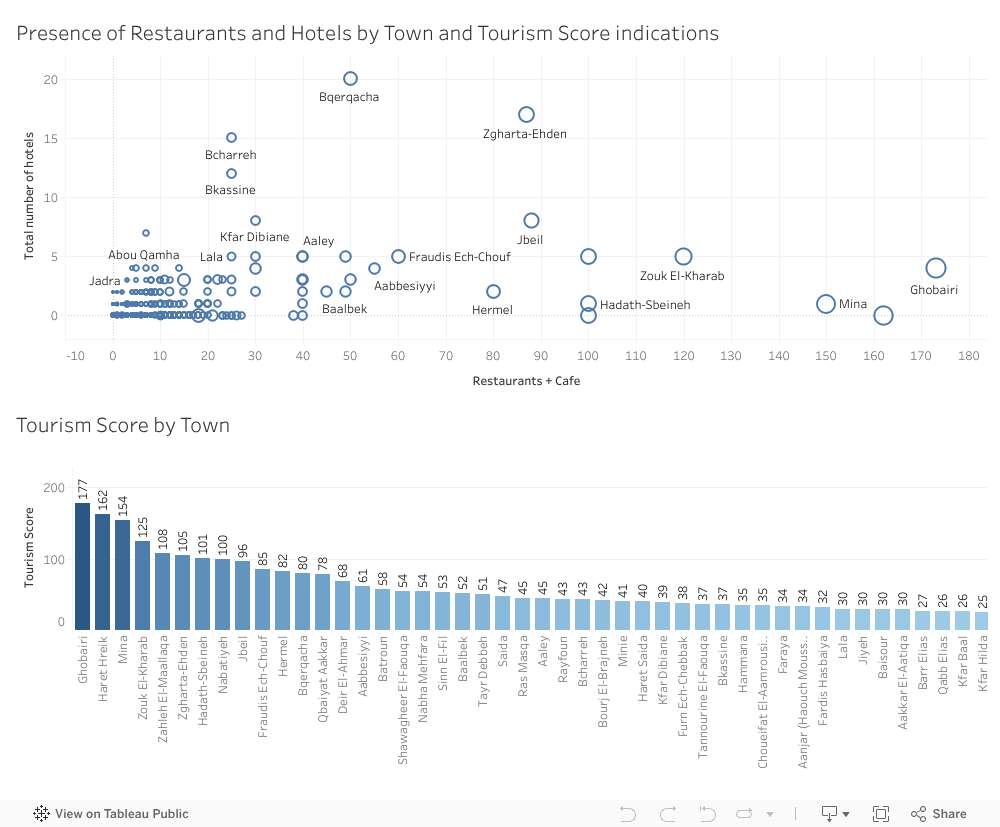
The scatterplot shows that just a small number of towns have both high numbers of restaurants and cafes and multiple hotels. Towns such as Zgharta–Ehden, Bcharreh, and Bqerqacha stand out because they have a balanced mix of services that can support both short-term and overnight visitors.
-
Ghobairi and Mina show strong activity but limited overnight capacity
On the far right of the scatterplot, Ghobairi and Mina appear with very high numbers of restaurants and cafes but almost no hotels. This suggests strong commercial and visitor activity but mainly in the form of day visits rather than extended stays. Their dense hospitality presence raises their tourism scores even though accommodations are limited.
-
The Tourism Score reveals unexpected top-ranking towns
The Tourism Score bar chart shows that the towns with the highest tourism potential are not always the ones typically associated with tourism. Ghobairi ranks first with a score of 177, followed by Haret Hreik and Mina. Meanwhile, popular tourist towns such as Zahle, Jbeil, and Zgharta–Ehden perform well but do not lead the ranking. This shows that infrastructure, more than reputation, determines tourism readiness.
-
Most towns have very limited tourism infrastructure
A large cluster of points near the origin of the scatterplot shows that most Lebanese towns have fewer than 10 restaurants and almost no hotels. These towns may rely on nearby hubs or seasonal tourism, but they lack the facilities needed to attract or accommodate visitors consistently.
-
Urban density influences tourism scores more than geography
The data suggests that high-scoring towns tend to be commercially dense and urbanized rather than simply scenic or historic. This highlights the importance of services such as dining and accommodation options as the real foundation of tourism potential.
Conclusion
The dashboard reveals that tourism activity in Lebanon is unevenly distributed. A small number of towns dominate because they offer the right mix of infrastructure, while many others, despite natural or cultural advantages, lack the essential services needed to support consistent tourism. These findings point to two opportunities. First, towns rich in natural or cultural attractions but lacking infrastructure could benefit from targeted development. Second, high-scoring, service-dense towns can act as anchors for broader regional tourism strategies. Understanding these patterns through data helps support more balanced tourism development across the country and encourages investment where it can make the most meaningful impact.