If you lived in Lebanon during the summer of 2015, you remember the smell before you remember the headlines. The waste crisis seeped into every street, every balcony, every bus ride. Mountains of uncollected trash became part of the landscape, and for a moment it felt as if the country itself had stopped breathing.
Nearly a decade later, that memory hasn’t faded, not because it’s distant, but because it never fully left. Today, we still step out for a walk and brace ourselves for the familiar sting of a garbage pile baking under the sun. We navigate around dumped furniture abandoned on sidewalks, pass corners where torn bags reveal forgotten clothes, and catch the lingering scent of waste that has become an unwelcome companion in many public spaces.
Lebanon’s waste crisis did not begin in 2015, and it certainly didn’t end there. But that moment marked a turning point, a reminder of how fragile our systems are and how urgently we need solutions that last.
The waste problem goes back way before 2015, and as a response to it, arcenciel started working towards sustainable practices in Lebanon that led to the creation of its Environmental Program.
In a country where waste is burned in the open, dumped along riverbeds, or left to rot in overflowing landfills, arcenciel has spent decades building powerful systems that protect both people and the environment through four units within its Environment Sector: DERE (Solid Waste Recycling), DEHO (Hospital Waste Treatment), the Social Boutique (circular economy initiative for clothing waste), and the Brocante (circular economy initiative for unwanted furniture and household items).
1. DEHO: Saving Lives During the Pandemic
arcenciel operates specialized facilities that collect, sterilize, and shred infectious medical waste, converting it into non-hazardous material suitable for regular disposal.
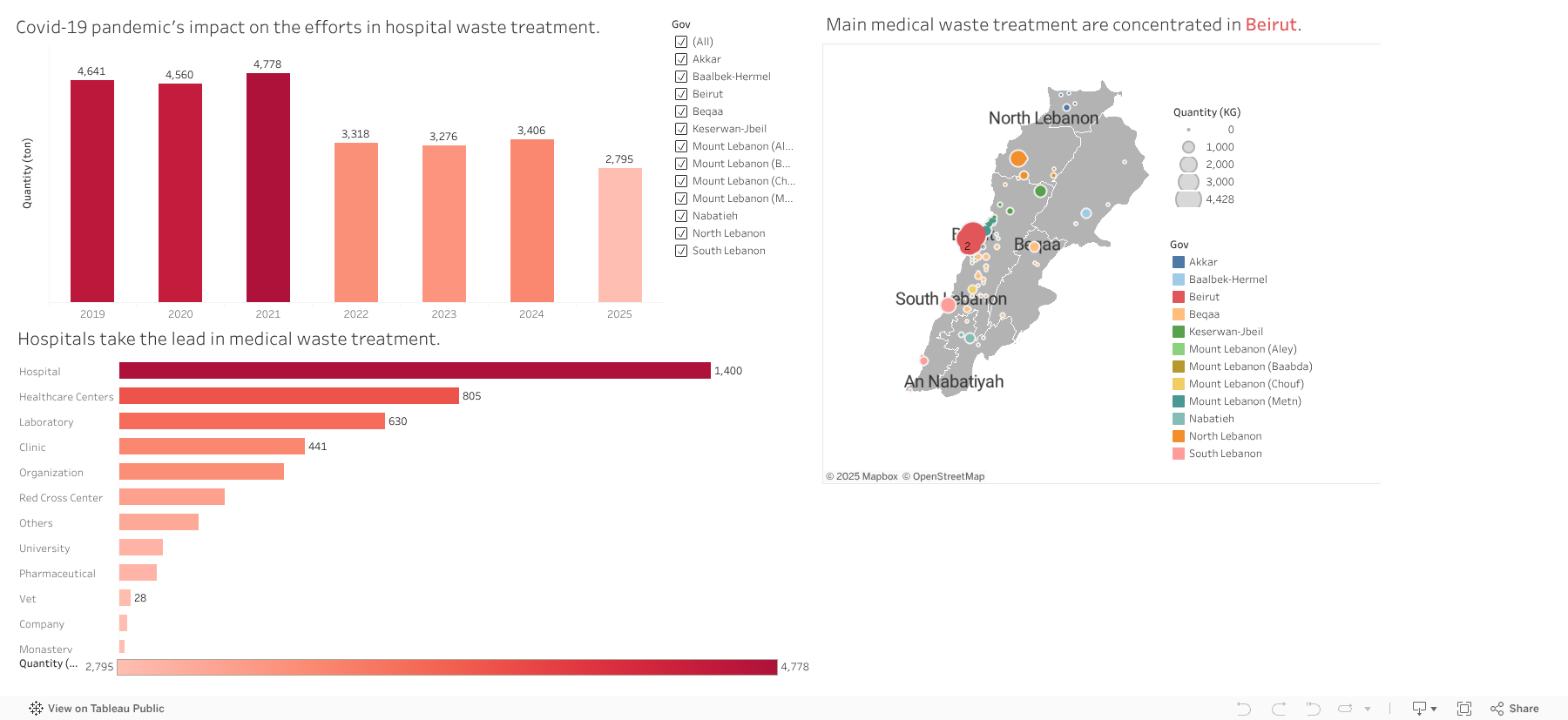
When we looked at the timeline of medical waste in Lebanon, one pattern immediately stood out. Between 2019 and 2021, the curve shoots upward, a sharp peak that mirrors the most intense years of the COVID-19 pandemic. In those years, DEHO handled record quantities of medical waste, reaching nearly 4,700 tons. Behind those numbers were packed hospital corridors, nonstop testing, and the global scramble for disposable protective equipment.
But the story shifts after 2022. As the pandemic slowly loosened its grip, medical waste volumes began to fall. By 2025, at least up to mid-October, the total had dropped to around 2,795 tons, signaling a gradual return to more typical levels.
The client landscape tells its own part of the story. Unsurprisingly, hospitals dominate, making up the largest share of medical waste generators, around 1,400 institutions. They’re followed by healthcare centers, labs, and clinics. Yet one detail we hadn’t expected emerged quietly in the data: veterinary practices. There are only 28 of them in the system, but they still appear as steady contributors to DEHO’s operations, a reminder that “medical waste” extends beyond human healthcare.
On the map, another pattern comes into focus. The brightest cluster sits right where you’d expect, Beirut, home to the country’s biggest hospitals and medical centers. Mount Lebanon forms a secondary ring, and beyond that, smaller dots scatter into Bekaa and the North. The geography of medical waste, it turns out, closely follows the geography of healthcare itself.
2. DERE: The Decline of Solid Waste Recycling
For many people, arcenciel’s Rolling Caps project is the first thing that comes to mind when they think about recycling, a simple act of collecting plastic caps that grew into a nationwide habit. But as we dug deeper into the DERE dataset, it became clear that the story of solid waste management goes far beyond bottle caps. It is, in fact, a story of quiet decline.
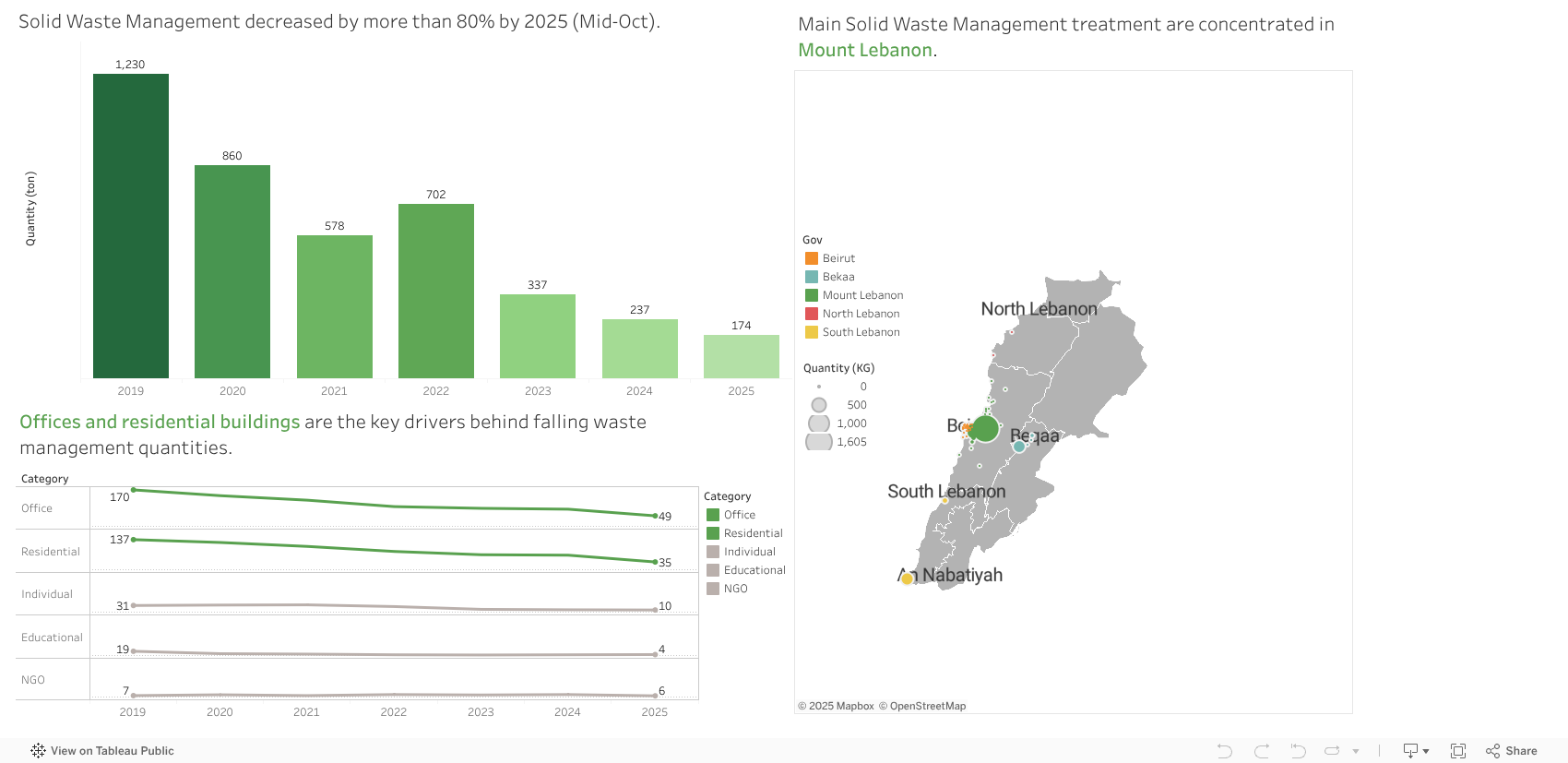
Between 2019 and mid-October 2025, the amount of solid waste managed by arcenciel fell by more than 85%, from 1,230 tons to just 174 tons. This isn’t a sudden dip; it’s a steady, multi-year decline that signals a deeper shift in how waste is being generated, sorted, and collected in Lebanon.
The drop becomes even clearer when looking at who’s producing this waste. Offices and residential buildings, once the core of the system, have significantly pulled back. Office clients shrank from 170 to 49, and residential buildings from 137 to 35. NGOs and individuals stayed relatively stable but remain small contributors, while educational institutions almost disappeared from the client base altogether. The trend points to a broader decline in organizational participation in recycling practices.
Spatially, most activity is concentrated in Mount Lebanon, with far less taking place in Beirut and very little in the Bekaa. This pattern mirrors our survey responses, suggesting similar geographic trends in both waste generation and public engagement.
For many, the Rolling Caps project remains the most memorable symbol of arcenciel’s recycling efforts, a simple initiative that caught national attention. Yet the data shows a more complex reality: solid waste management has been steadily shrinking, reminding us of the work needed to rekindle participation and rebuild trust in sustainable systems.
3. Social Boutique: Clothing Donations as a Social Lifeline
If DERE shows us how waste declines, the Social Boutique shows us how resources circulate. At its heart, the boutique is a simple but powerful idea: clothing donated by the public is sorted, repaired, and redistributed to families who need it most. What arrives as a bag of used clothes leaves as warmth and support.
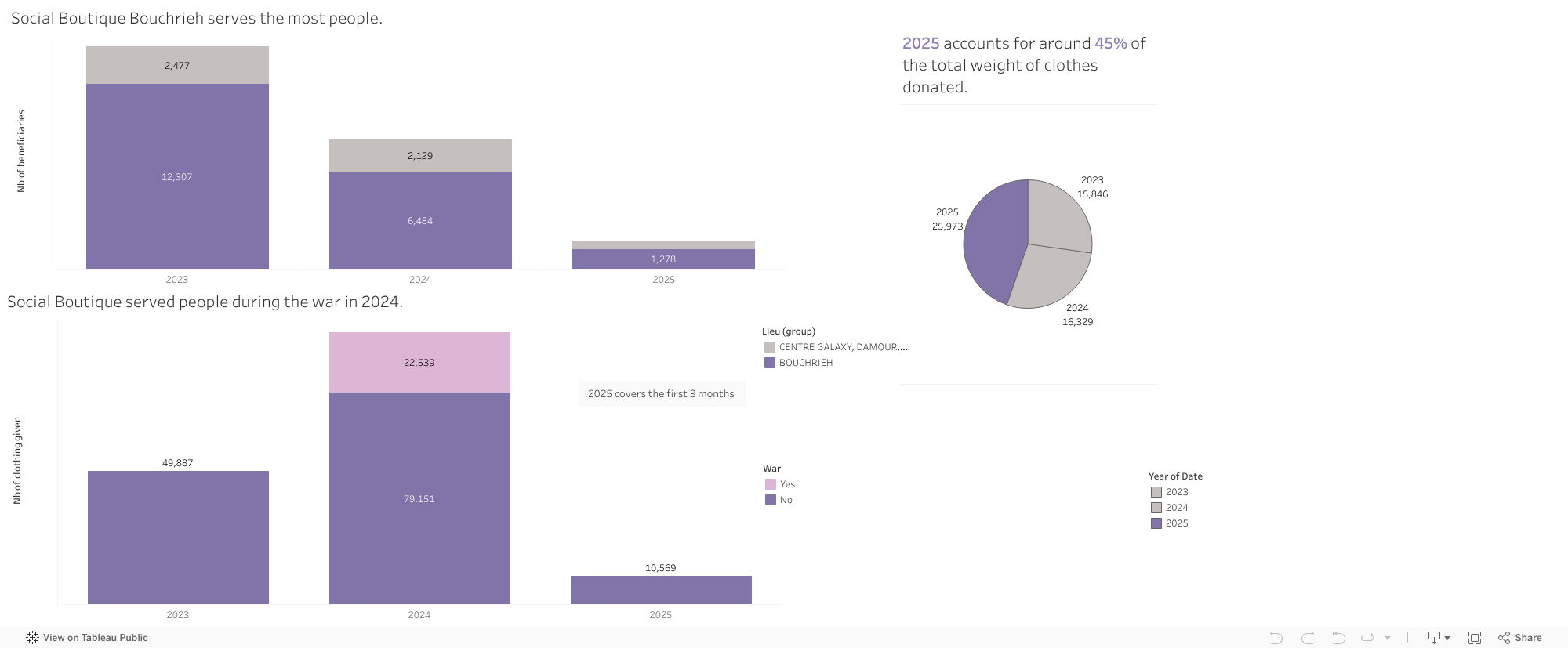
From 2023 to 2025, the data reveals an interesting pattern. Even though 2025 only includes records up to mid-October, it already accounts for an unusually large share of the total clothing weight collected, suggesting early-year surges or improvements in how donations are handled. The Bouchrieh center stands out as the busiest hub, serving more than 12,000 people in 2023 and over 6,000 in 2024, with Zahlé and Galaxy following behind at smaller but meaningful scales.
One spike in the data is impossible to ignore: in late 2024, over 22,000 clothing items were tagged as war-related. These represent urgent distributions during October to December, when thousands of families were displaced and in need of immediate support.
But the Social Boutique’s impact isn’t just in the items it collects it’s in the people who make it all work. The team is mostly women, many from vulnerable backgrounds, including women with disabilities. Through steady employment and community support, they turn donated clothes into a lifeline for others, becoming key players in Lebanon’s circular economy.
4. Brocante: Furniture Reuse and the Circular Economy in Action
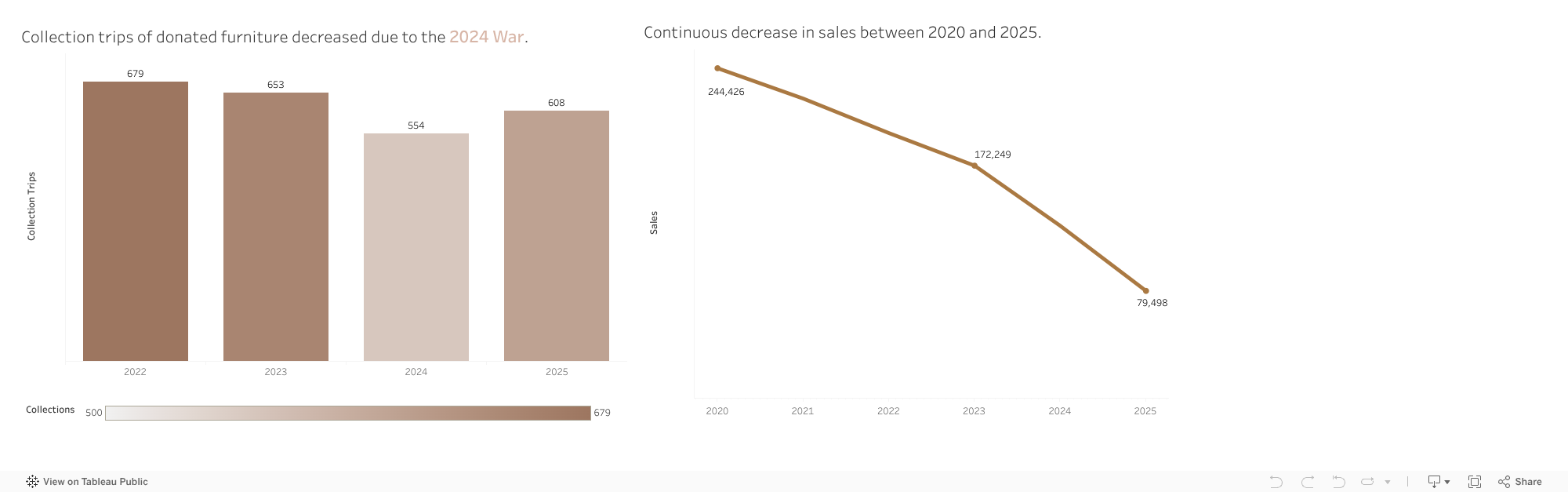
The Social Boutique tells the story of clothing, then the Brocante tells the story of furniture, the heavy, bulky pieces that often end up on sidewalks or abandoned during crises. Instead of becoming waste, these items enter arcenciel’s circular economy: collected from homes, repaired when needed, and resold at accessible prices to support the organization’s sustainability. Furniture often ends up on sidewalks, in empty lots, or in landfills, but the Brocante transforms these discarded items into opportunities. The collection trip data reveals patterns shaped by Lebanon’s crises. Trips declined during 2024, reflecting war-related mobility challenges, but rose again in 2025.
The data shows a mixed pattern in collection activity. Between 2022 and 2025, the number of collection trips, each representing at least one donated furniture or household item, fluctuated. Trips dropped from 679 in 2022 to 554 in 2024, before rising again to 608 in 2025 (with data only until October). The dip in 2024 isn’t random; it mirrors the disruptions of the 2024 war, when mobility, relocations, and donation patterns were heavily affected.
Sales, however, tell a clearer story. From 2020 to 2025, total revenue from Brocante items steadily fell from 244,426 USD to 79,498 USD. But this decline isn’t about fewer donations or lower demand. As the Environment Sector lead explained, it reflects an operational gap: the closure of the Galaxy Mall showroom in December 2024 and the delayed opening of the new Zalka Eco Hub in April 2025. With no physical space to sell items for several months, early 2025 shows a sharp drop in revenue, a logistical pause rather than a weakening of the model.
Despite these fluctuations, the Brocante remains a cornerstone of arcenciel’s approach to circularity, turning what might have become trash into both environmental and financial value.
Recycling at home and giving your recyclables to arcenciel
Donating clothes or furniture
🗺️ Collection points are available at all 10 arcenciel centers across Lebanon.
📧 For large quantities of recyclables, furniture, or clothing, contact: info@arcenciel.org
What about the future?
If the present reflects the weight of Lebanon’s challenges, the future reflects the power of what its communities can achieve when circularity, inclusion, and sustainability are not just ideas, but everyday practice. And this future is not theoretical, it is already beginning, one recycled bottle, one hospital partnership, one donated chair, and one empowered individual at a time.
Somewhere in the hills of Akkar, a mother wakes before dawn. Her son is burning with fever, his tiny chest rising in short, frightened breaths. She wraps him in a blanket, steps outside and faces the same impossible truth every family in her town lives with:
There is no clinic here. No doctor. No nearby care.
The closest medical help is more than an hour away—if roads are clear, if transportation can be found, if nothing goes wrong. For her, and for nearly half of Lebanon’s towns, simple illnesses can become life-threatening journeys. It is not just a healthcare issue, It is a daily, silent tragedy that shapes entire lives.
What the Data Shows but the Country Ignores
The visuals map this tragedy with painful clarity.
In the bar chart:
49.74% of Lebanese towns have no local resources nor nearby healthcare.
17.08% have no local facilities but can sometimes reach distant care. Only 33.19% enjoy the basic dignity of accessible treatment.
The map shows Lebanon carved into colors that reveal the geography of abandonment.
Akkar, North Lebanon, Baalbek-Hermel, and Bekaa glow in urgent shades of red.
Beirut and Mount Lebanon rest confidently in green.
Though South Lebanon contains the highest danger percentage, it is covered with governorates that contain abundant amount of medical facilities and resources.
The visuals prove what families in rural regions already know: healthcare access in Lebanon is not just unequal—it is deeply, structurally unfair.
The danger zones are not random, they follow the borders of poverty, neglect, and distance.
A Country at a Crossroads
Yet Lebanon is not without hope. Around the world—and even within its own borders—innovative models show that remote and underserved communities can receive consistent care. The country stands at a crossroads where solutions are known, feasible, and within reach.
Lebanon can choose a future where no mother must gamble with her child’s life because of distance.
That future begins with a hybrid healthcare access model designed for real Lebanese terrain, real Lebanese families, and real Lebanese limitations.
Building the Path Forward
The path unfolds in two phases—immediate relief and lasting transformation.
Immediate Relief
Mobile clinics traveling weekly into remote towns.
Telehealth services connecting residents with doctors online.
Community health workers offering first aid, monitoring chronic diseases, and stabilizing emergencies.
These solutions bring healthcare to the people, rather than asking the people to chase it.
Long-Term Transformation
Expanding rural Primary Healthcare Centers (PHCs) in governorates painted red in the danger map.
Incentivizing private and nonprofit partnerships to open satellite clinics.
Improving transportation links so that even without a local clinic, emergency care is reachable.
This approach does not just fill gaps, it builds a system where every town becomes medically reachable, no matter how far, no matter how rural.
Why This Will Work
Proof already exists.
Organizations like MSF, the Lebanese Red Cross, and multiple NGOs have successfully delivered mobile and remote care across Lebanon’s hardest-to-reach regions. Telehealth has grown worldwide, saving millions in rural communities and the data that drives these charts, maps, and analyses pinpoint exactly where interventions must be prioritized.
The strategy aligns with Lebanon’s national health vision and mirrors international best practices in countries with similar geography and instability.
It is not theory. It is tested, validated, and realistic.
Beyond the Diagnosis
The visuals do not simply highlight shortages, they illuminate where change must begin.
The Truth
Lebanon’s healthcare inequality is regional and predictable, not accidental.
Rural northern and eastern regions are in critical danger, lacking both local and nearby care.
Nearly half of Lebanese towns face severe accessibility barriers.
The Solution
Deploy mobile and telehealth clinics immediately to stabilize high-danger governorates.
Invest in long-term PHC expansion to ensure durable access.
Integrate transportation and healthcare planning, recognizing that distance is often deadlier than disease.
Maintain data-driven monitoring to continuously reallocate resources to evolving needs.
If Lebanon acts now and not later, the red zones can fade. Families can breathe easier. Lives can be saved.
A Different Dawn
One day, perhaps, a child in Akkar will still wake before dawn—but instead of gasping for breath, he will leap from bed to greet a new school day. His mother will no longer fear the distance to care.
Because care will finally be within reach. Because the map will no longer define who survives and who struggles. Because Lebanon will have remembered its forgotten towns.
That is the story the data tells. That is the story this country can still rewrite.
“We are alive the most when we are faced with adversity like no other.”
Tourism has always been one of Lebanon’s brightest sectors, bringing life, movement, and opportunity to towns across the country. But when we look closely at where this activity is actually happening, an important pattern becomes clear: tourism is not spread evenly. It is concentrated intensely in just a handful of towns. And with that concentration comes one of Lebanon’s biggest hidden challenges: environmental pressure.
Restaurants, cafés, and hotels create jobs, attract visitors, and fuel local economies, but they also generate large amounts of waste, rely heavily on single-use plastics, and demand significant water and electricity. When these establishments cluster together in small areas, the strain on municipal systems becomes visible faster than the benefits.
To understand this pressure, we visualized the distribution of tourism establishments across the top 10 tourism towns in Lebanon. The result was striking. Two towns, Aabbesiyi and Baalbek stood far above the rest.
Aabbesiyi hosts 30 restaurants, 25 cafés, and 4 hotels. Baalbek hosts 39 restaurants, 10 cafés, and 2 hotels. Together, they make up 55% of all tourism establishments among the top towns.
This isn’t a small detail. This is the story.
These two towns carry more tourism activity, more food and packaging waste, more daily electricity and water consumption, and more visitor movement than anywhere else. And because the environmental impact is highest where the activity is highest, this concentration creates an opportunity that Lebanon has never fully used: beginning sustainability efforts where they matter most.
Instead of trying to build a national sustainability plan all at once, we can start with a focused, practical approach. Aabbesiyi and Baalbek are ideal places to pilot a Sustainable Tourism Starter Program, a coordinated effort that brings together cafés, restaurants, hotels, municipalities, and visitors under a simple goal: reducing the environmental footprint of the tourism experience.
Why start here?
Because here, the impact is immediate.
Because here, businesses are clustered close enough to benefit from shared guidelines and joint awareness efforts.
Because here, improvements don’t just make environmental sense, they make social and economic sense too.
Global sustainable tourism frameworks follow the same principle: begin where tourism activity is heaviest. It creates quicker results, easier monitoring, and a clearer path for scaling what works. And both Aabbesiyi and Baalbek already have something many towns lack: active business communities, strong visibility, and a steady visitor flow that makes sustainability initiatives more likely to succeed.
From shared sustainability guidelines to town-level branding like “Green Aabbesiyi” and “Eco-Baalbek,” these hubs can become the first Lebanese destinations to embrace environmental responsibility as part of their identity. With support from NGOs, municipal authorities, schools, and local partners, the program can grow beyond awareness campaigns into a committed, long-term approach to managing waste, water, energy, and visitor behavior. And once we see the impact, once the model proves itself, the same practices can be adopted by other towns, one step at a time.
Our visualization points to one undeniable truth: not all tourism towns carry the same environmental weight. Turning this insight into action gives Lebanon a real chance to move toward a greener tourism future, starting exactly where impact will be felt most.
In the unfolding narrative of global environmental challenges, the tale of the United States and China emerges as a compelling story of shifting roles and responsibilities in the battle against climate change.
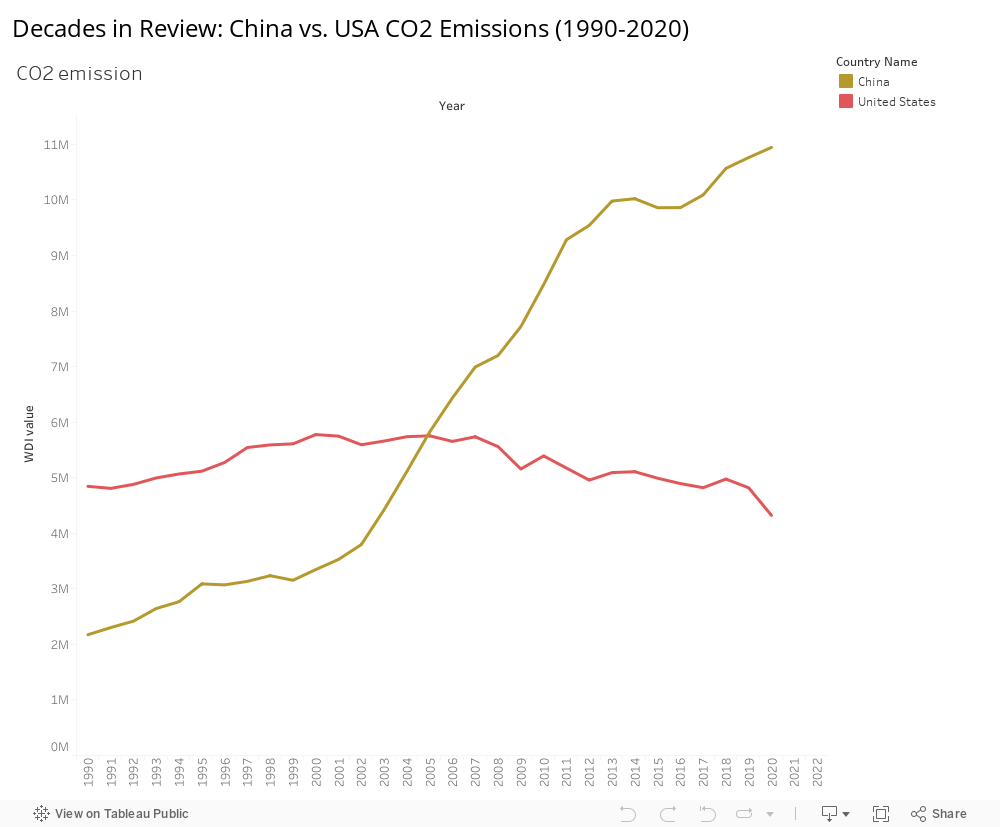
The visual representation of CO2 emissions between the United States and China from 1990 to 2020 on a line chart underscores a critical environmental challenge. The problem lies in the discernible shift of emission supremacy between the two nations, with the USA leading until 2005, at which point China surpassed it. This transition is indicative of a broader issue: the need for a collective, global response to address escalating carbon emissions. The evidence is clear—the historical dominance of the United States in emissions, followed by China’s ascent—underscores the urgency of finding a sustainable solution. The potential remedy to this issue requires a multifaceted approach. Firstly, international collaboration is paramount, necessitating joint efforts in clean energy initiatives, sharing technological advancements, and leveraging collective resources. Secondly, a focus on renewable energy sources, coupled with substantial investments in carbon capture technologies, is crucial. Additionally, stringent emissions regulations and their effective enforcement should be implemented, with governments playing a pivotal role in setting and monitoring emission reduction targets. A comprehensive solution also involves public and private sectors prioritizing sustainability, embracing energy-efficient practices, and fostering innovation. In conclusion, the story depicted by the line chart serves as a clarion call for immediate and concerted action. Recommendations include fostering global collaboration, prioritizing renewable energy, implementing robust regulations, and cultivating a collective commitment to a sustainable future—a future where the line chart reflects a downward trend in CO2 emissions for both the United States and China.
Can you imagine our amazing Lebanese moderate climate that we have all loved turning into an exceptionally scorching or freezing weather condition?
Climate change has become a global concern, with impacts felt across all nations and regions. It messes up countries’ economies and comes with big costs now and in the future, affecting people, communities, and nations deeply.
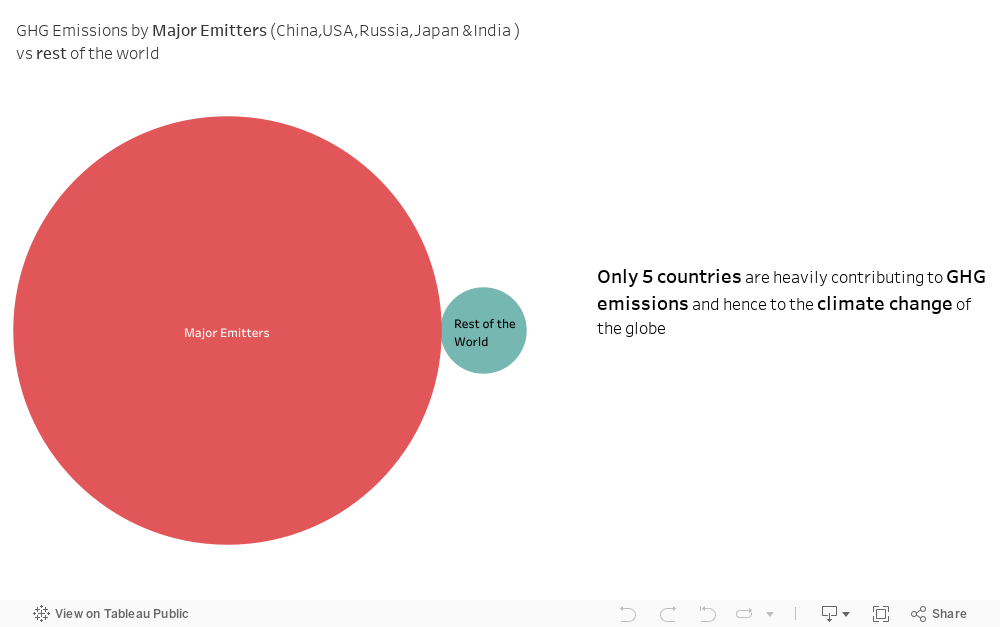
This change is directly related to human actions and interventions. Only 5 countries represent the global major emitters and are mainly contributing to this effect through Greenhouse Gas Emissions.
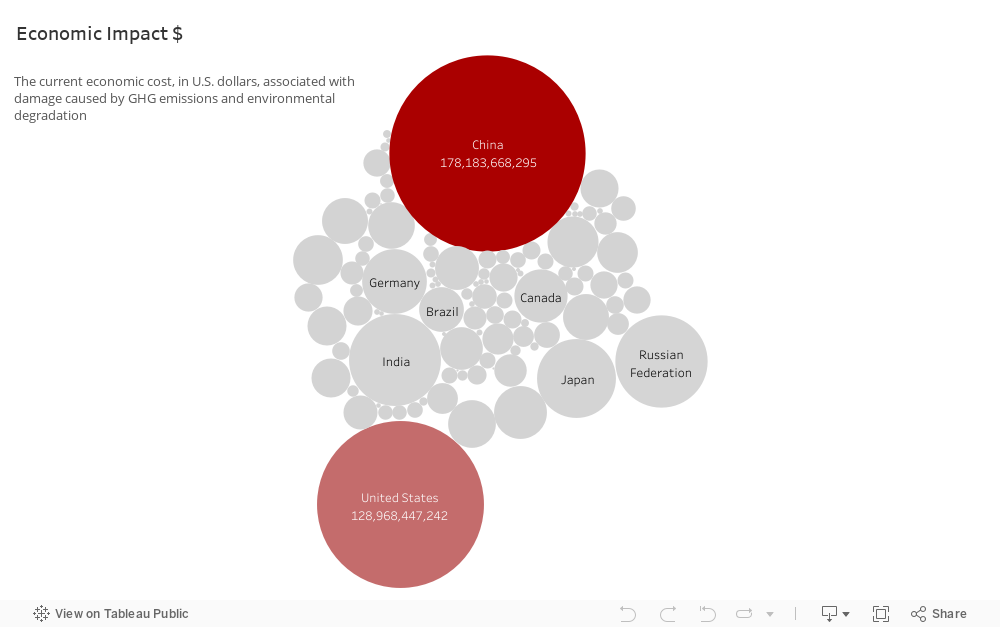
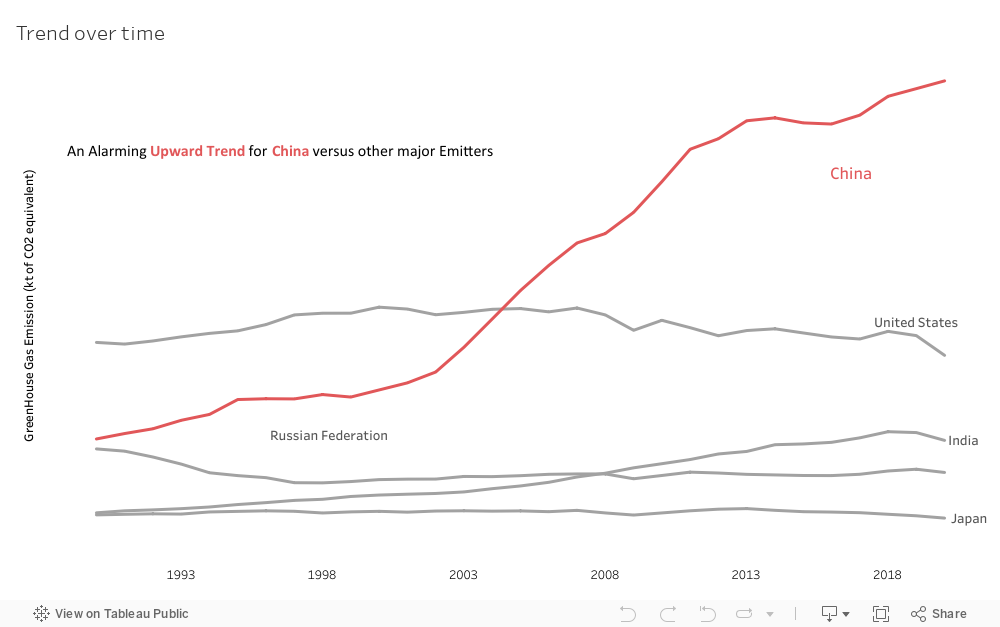
It’s important to highlight that what’s even more concerning is the lack of substantial strategies and significant efforts by these nations to diminish their contribution to greenhouse gas emissions and, in turn, global warming. China, in particular, demonstrates a noticeable upward trajectory in GHG emissions.
Can we control and minimize these green house gas emissions ? Can we prevent our climate change and have a more sustainable environment ?
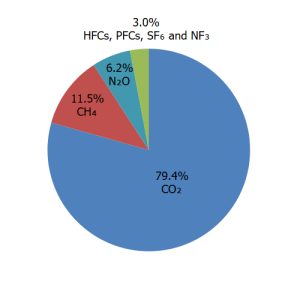
CO2 , CH4 and N2O are major gases contributing to Global Warming as per below chart:
Hence, investigating the sources of these gases and identifying the most influential source contributor will unveil the underlying issue, offering a solid foundation from which to initiate efforts aimed at reducing their presence and subsequent impact
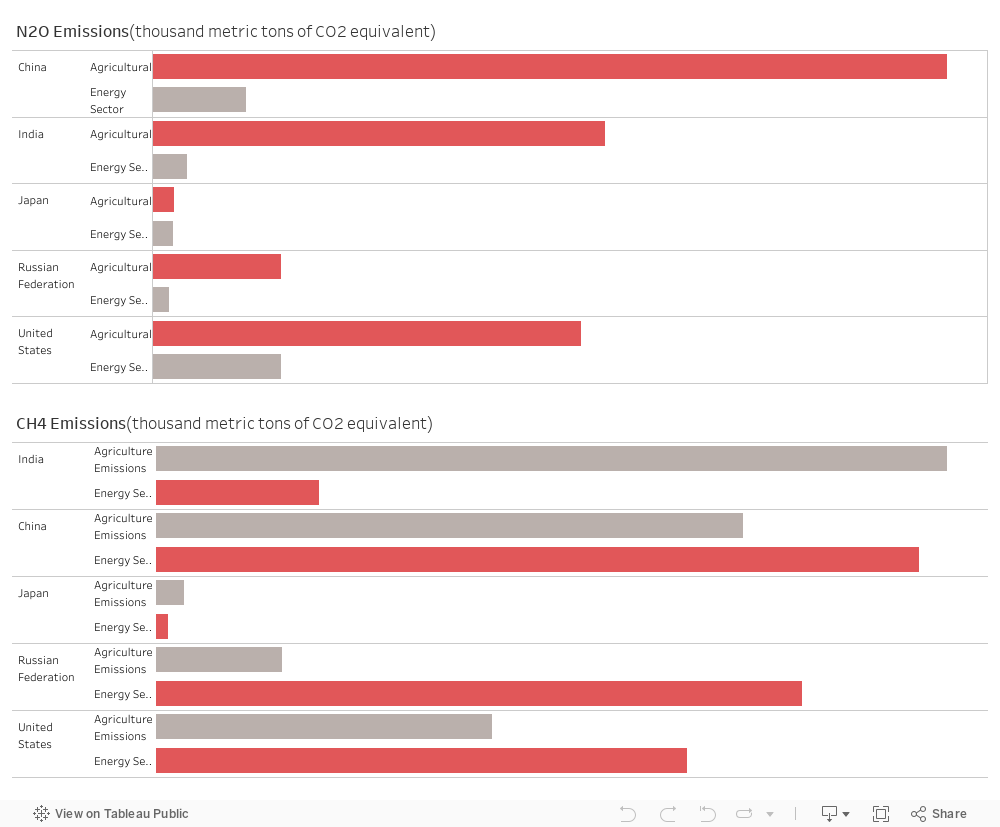
Data reveals that bad agricultural practices are major source of NO2 emissions in major emitters whereas Energy generation is the major source of Methane in this group except for India and Japan.
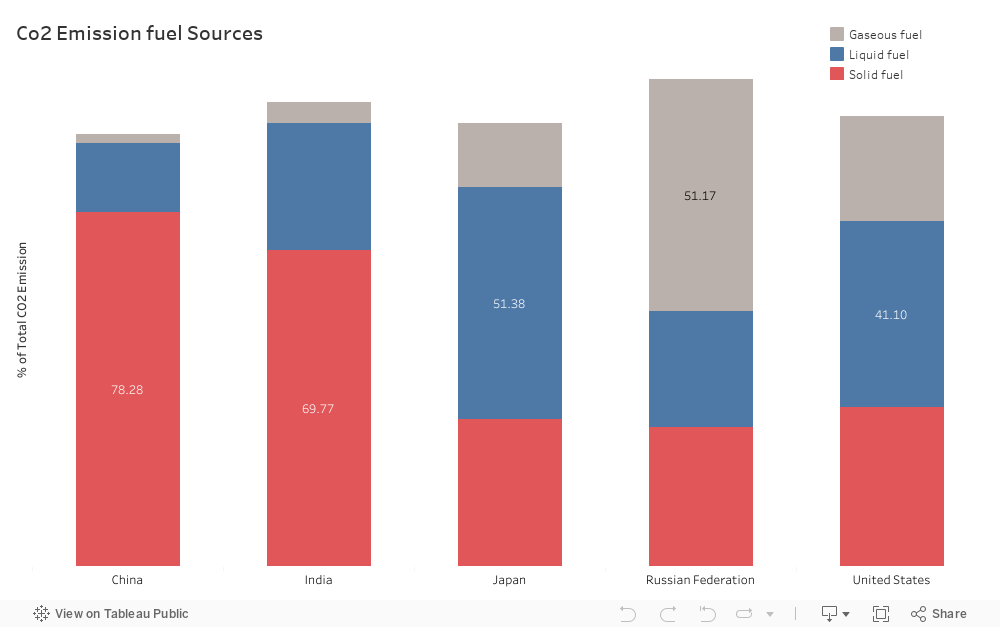
A central concept is that fuel usage stands as the primary driver of CO2 emissions. To delve deeper, we will analyze the predominant form of fuel consumption in each country by examining the average percentage distribution across various sources. Solid Fuel is major source in China and India, Liquid Fuel is major source in Japan and USA whereas Gaseous Fuel is major source in Russia.
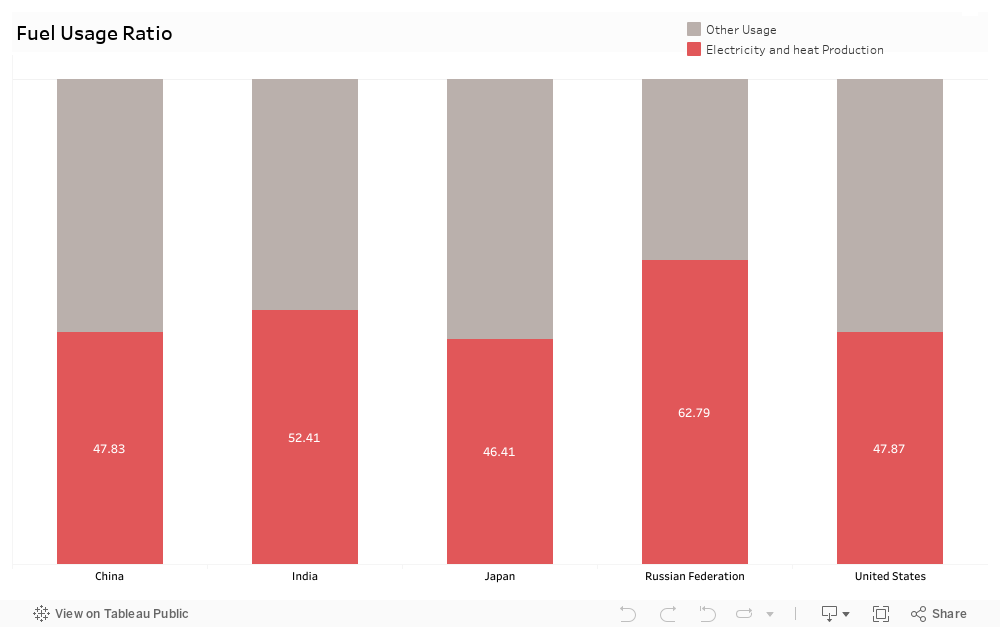
Where is the fuel mainly used?
Powering the World : Exposing the insatiable hunger for energy in the captivating domains of electricity and heat production.
Potential Solution
Hence, the solution lies squarely in human actions and interventions. Opting for organic farming, free from chemical inputs, can significantly reduce harmful gas emissions. Additionally, a shift to renewable energy sources such as solar and wind will substantially decrease greenhouse gas emissions, contributing further to a sustainable future and climate protection. As an example, Brazil that generates around 46 % of its energy from renewable sources generates GHG emissions that constitute just 5 % of China’s and 7 % of USA emissions.
It is not fair that only around 25 % of the globe area is the major source of GHG emissions, climate change and environmental degradation. We must transition towards more sustainable actions and behaviors to ensure a more resilient future for our planet.
Recommendation
The urgent need for a global sustainability committee is evident, and the starting point is the creation of the “Major Emitters” group. This committee aims to be a central force guiding worldwide sustainable initiatives, encouraging collaboration among nations to address environmental challenges and cultivate a resilient global ecosystem. The Major Emitters entity is positioned to lead this effort, uniting influential contributors and paving the way for collective action in the pursuit of a sustainable future.