Data Visualization

Blog of the Data Visualization & Communication Course at OSB-AUB

This is my favorite part about analytics: Taking boring flat data and bringing it to life through visualization” John Tukey

Lebanon’s Financial Access Isn’t Equal

Lebanon’s Financial Access Isn’t Equal

In Lebanon, where you live determines much more than scenery or lifestyle, it quietly shapes the financial services you can access. For many communities, financial institutions are the backbone of how people save, borrow, and plan their futures. But what if that backbone isn’t equally strong everywhere?
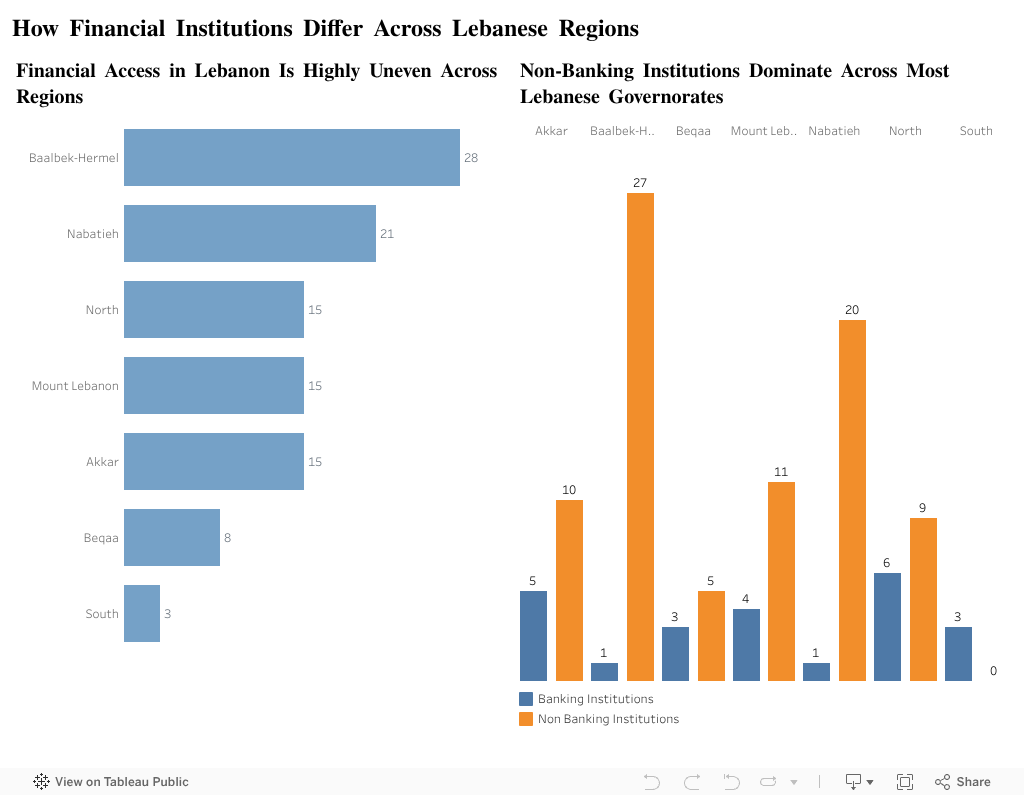
As soon as we break the numbers down, the imbalance becomes unavoidable.

Some regions — like Baalbek-Hermel and Nabatieh — appear well-served, hosting the highest counts of institutions.

Others, especially the South, have only a handful, making financial access significantly more limited.

Then the story takes its first real turn when we separate banks from non-banking institutions:

  • Banks rarely exceed single-digit presence anywhere.

  • Non-banking institutions dominate nearly every governorate, often by a wide margin.

This raises the dramatic question:

If banks are the exception, what does financial access actually look like across Lebanon?

The implications are real:

  • In regions with very few institutions, people must travel farther, pay more, or rely on informal channels.

  • In regions with many institutions, non-banking organizations still dominate, shaping how communities interact with money.

The struggle isn’t about having some financial services , it’s about which services are available, and what that means for people trying to manage their financial lives.

The story ends with a clear understanding:

Lebanon’s financial landscape is not only uneven, it is structurally different from one region to another.

Recognizing this imbalance is the first step toward improving financial inclusion. If we want to strengthen financial resilience across Lebanon, we must:

  • Address regional disparities in financial access.

  • Understand the key role non-banking institutions play for many communities.

  • Acknowledge that where people live directly shapes the financial tools they can depend on.

Ultimately, this visualization calls us to rethink how we define “financial access”, and to consider how policy, investment, and community support can bring the system back into balance.
National Debt & Population Income

National Debt & Population Income

Does a Country’s Borrowing Policy Affect its Population’s Income level?

The Case of Lebanon


DOLLAR? LBP?       

WHAT’S THE EXCHANGE RATE TODAY?

DISCOUNTING CHECKS? AT WHAT RATE?

WHAT????     20%????

THIS MEANS I’M LOSING 80% OF MY MONEY!!!

I WAS DOING OK BUT NOW I CAN BARELY MAKE ENDS MEET…  


This has unfortunately been the sad reality that
theLebanese people have been living for since
October of 2019.


WHY?


Because a Banking | Financial | Currency | Crisis

Made a Huge Bubble Burst!                                             


BUT HOW DID WE GET HERE?

Lebanon has had a budget deficit for over 20 years
and has been borrowing from external parties
for as long as we can remember.

So, as Lebanese citizens, we are born indebted.


A country’s national debt affects its population’s income level:

  • Growing debt has a direct effect on economic opportunities

  • If high levels of debt crowd out private investments, workers would have less to jobs do and therefore earn lower wages

Countries with LOWER DEBT exhibit HIGHER INCOME levels per capita.


SO HOW HAS LEBANON’S DEBT BEEN CHANGING OVER TIME?


WHAT CAN WE DO TO MAKE THINGS BETTER?

Potential Solutions include but are not limited to:

  • Supporting Production and Services Sectors leading to more Job Creation and eventually More Wages

  • Improving Trade Agreements leads to more exports which would Reduce Budget Deficits and make the country economically healthier

  • Attracting Foreign Direct Investments by providing a healthy capital market (ex: improving Reporting Practices) which leads to More Investments & More economic opportunities, More Jobs and eventually More wages


IS THERE PROOF?


Countries with Open Trade Policies seem to have higher income levels


Countries with Updated Reporting Practices also have higher income levels

SO, WHAT ARE THE RECOMMENDATIONS?

STOP borrowing from international Agencies

CONTROL High National Debt Levels


Implement Policies to boost the economy