Data Visualization

Blog of the Data Visualization & Communication Course at OSB-AUB

This is my favorite part about analytics: Taking boring flat data and bringing it to life through visualization” John Tukey

Lebanon: an unequal geography of Education

Lebanon: an unequal geography of Education

I will never forget his name.
Omar. He was about my age, walking around the street and asking for directions. He stopped me but I didn’t know the place, so I suggested trying it on Google Maps to see if he can find it. Omar looked at me, embarrassed, and told be he couldn’t do that. Why? Not because he didn’t have a phone, he did. Not because it didn’t have power, or connection, it did. But because he didn’t know how to read and write.
I consider myself to be one of the lucky ones.
I grew up in a world where education is a given, not a luxury, where graduating is a rite of passage not a privilege, where going to university is the norm, not the exception. I am one of the lucky ones because I never had to question all of this as a child. I never had to think about my life as being anything else than going to school. People like you and me, we forget that some people don’t know how to read, some barely know how to count, some stopped going to school at 12 years old. We take it all for granted. But when reality hits you like that, everything shatters. Today, I remind you of them, of the Omars of the world. We need to act now, today.
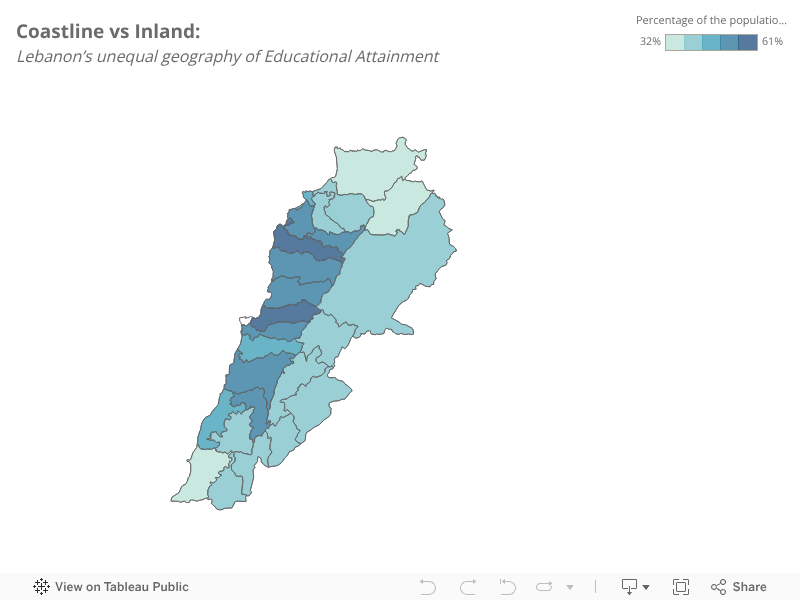
In Lebanon, where you live still decides what education you get…

But how can all of this be explained? What influences such disparity? What are the factors at play? These questions needed to be answered to find out the next course of action. The common denominator? The gap between the private and the public sector. It’s where inequality starts brewing.
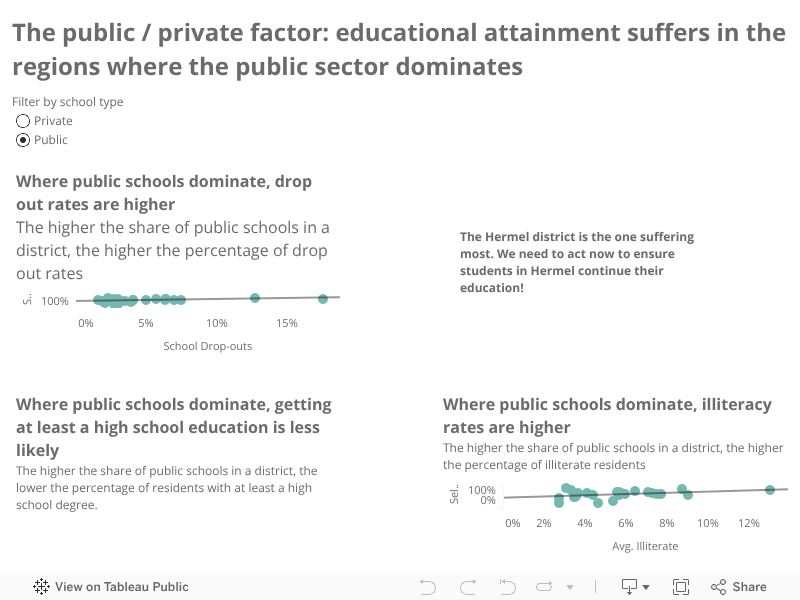
In the districts where the share of public schools is higher, the percentage of residents with at least a high school degree suffer and both drop-out rates and illiteracy rates grow. As such, the higher the percentage of private schools in the district you live in, the more likely you’ll make it to university. But, private education is expensive and not accessible to everyone, and getting public schools to catch up to the level of private ones takes a lot of time and requires a very big investment.
In the meantime, thousands of students are abandoning their studies… We need to bridge the gap, and fast. 

Educating about Education in the public sector.
The first step is awareness. We need to educate public students on the importance of continuing their education. If they don’t know why they should go on with their studies, then anything else we try, will fail. Through my NGO, I developed a program that we would like to test-run.

Our program is three-fold:

  • Highlights the importance of continuing an education and the long term benefits it provides.
  • Addresses the reasons why public school students typically abandon their studies, suggests solutions and frames education within those issues.
  • The program will be repeated and updated as students get from elementary to intermediate to secondary to assess new concerns tied to the evolving context in Lebanon, age-related concerns.

To do that, we need the ministry of education’s approval to begin activation within public schools. Ideally, we would like to start with Hermel, which is the biggest problem area, as it is the worst across in all 3 key measures. This ensures at the same time, that we maximize the number of students we’ll be able to help.

Equal access to education should not a child’s naive idea of reality, it should be the norm. I ask you to say yes, not for me, but for all for all the kids out there who won’t get a proper education because they were born in the wrong place. For those who have enormous potential, but will never get to reach it. For those who should have gone on to do great things. For Omar. For all the kids who were born a few kilometers inland.

Education vs Youth Unemployment: Trends in Lebanon & Jordan

Education vs Youth Unemployment: Trends in Lebanon & Jordan

Youth unemployment remains one of the most urgent socioeconomic challenges across the Middle East. By tracking long-term trends in Lebanon, Jordan, the OECD benchmark, and the global average, a clearer picture emerges of how different countries have navigated the last three decades, and how education connects to opportunity.

Youth unemployment is rising sharply in Lebanon and Jordan.

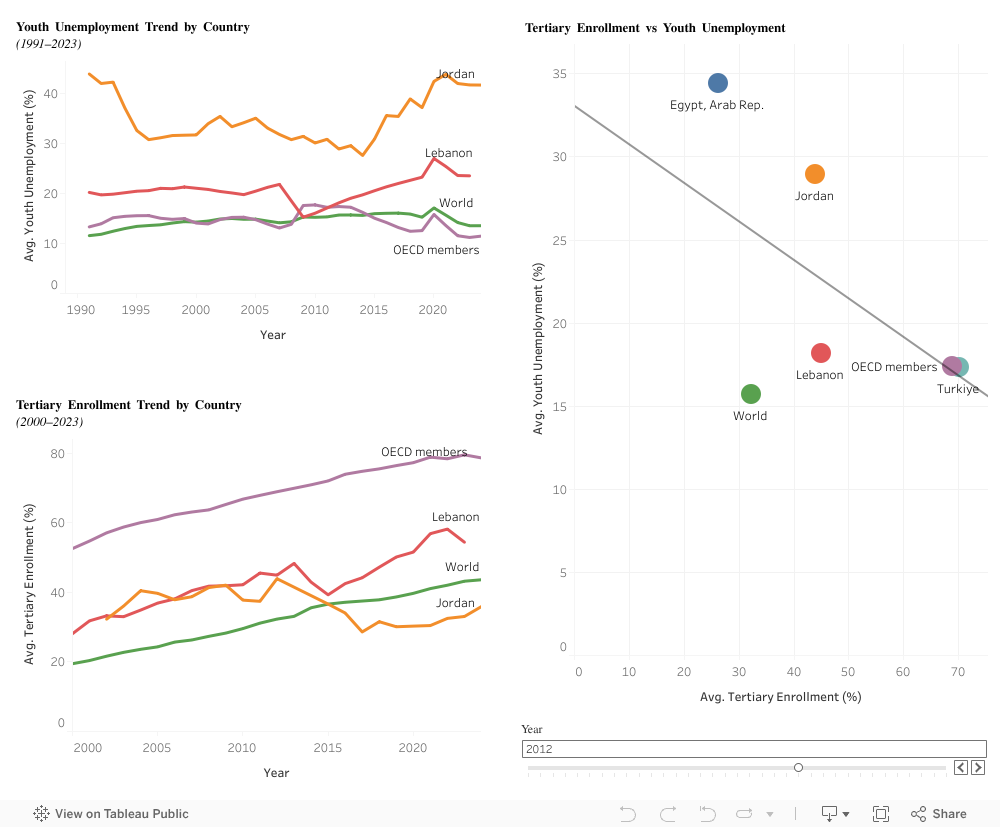
The long-run trend from 1991 to 2023 reveals a troubling pattern:

  • Lebanon starts in the low 20s but steadily climbs upward, especially after 2010, reflecting the country’s deepening economic crisis, political instability, and financial collapse.
  • Jordan begins around the mid-30% range and fluctuates over time, but recent years show unemployment rising again, approaching 40%.

In comparison:

  • OECD members maintain far lower levels, typically around 10–15%, representing healthier labor markets.
  • The world average stays in the mid-teens, serving as a neutral benchmark.

The gap between Jordan/Lebanon and OECD countries has widened over time, highlighting structural challenges in these Middle Eastern economies.

Lebanon stands out for a clear and concerning reason.

Lebanon’s youth unemployment has increased despite rising tertiary enrollment, making it distinct from global patterns.

Unlike OECD countries, where higher education is associated with smoother transitions into the labor market, Lebanese graduates face an economy unable to absorb them:

  • Businesses are closing
  • Emigration is rising
  • The labor market lacks stability
  • Economic growth is stagnant or negative

This creates a systemic mismatch between education levels and job availability.

Rising education doesn’t necessarily reduce unemployment.

The tertiary enrollment trends (2000–2023) show:

  • OECD members achieve the highest and most consistent growth in tertiary enrollment, and maintain the lowest unemployment rate.
  • Lebanon shows strong educational gains but no improvement in employment outcomes.
  • Jordan sees a gradual increase but continues to face very high youth unemployment.
  • The world average grows steadily, offering a smoother global reference point.

The patterns suggest that education alone does not reduce unemployment.

Instead, the labor market must have:

  • Economic stability
  • Job creation
  • Demand for skilled workers
  • A functioning political and financial environment

Without these, even highly educated young people struggle to find work.

The scatterplot reveals the core insight.

By allowing you to choose any year in the dashboard, the scatterplot compares:

  • Tertiary enrollment (%)
  • Youth unemployment (%)

in Jordan, Lebanon, OECD members, the World, and (in the scatterplot only) Egypt and Türkiye.

Across almost every year:

 Countries with higher tertiary enrollment generally have lower youth unemployment.

But Lebanon and Jordan consistently sit above the trendline, meaning:

  • Their youth unemployment is higher than expected
  • Their labor markets are not converting education into opportunity
  • Structural and economic constraints override the benefits of schooling

Meanwhile:

  • OECD countries fall well below the trendline, showing that strong education systems paired with strong economies lead to better youth employment outcomes.

Conclusion

Higher education helps, but only when economies create opportunities for young people. Lebanon and Jordan demonstrate what happens when education expands but economies fail to keep pace. The OECD shows the opposite: stable economies transform education into employment.

The key question becomes: How can Middle Eastern economies create labor markets that reward education rather than punish it?