
Consumer Segment Suffers the Sharpest Profit Drop as Discounts Increase
Most businesses offer discounts to boost sales and expect profits to follow.
And discounting does increase purchase likelihood for some customers.
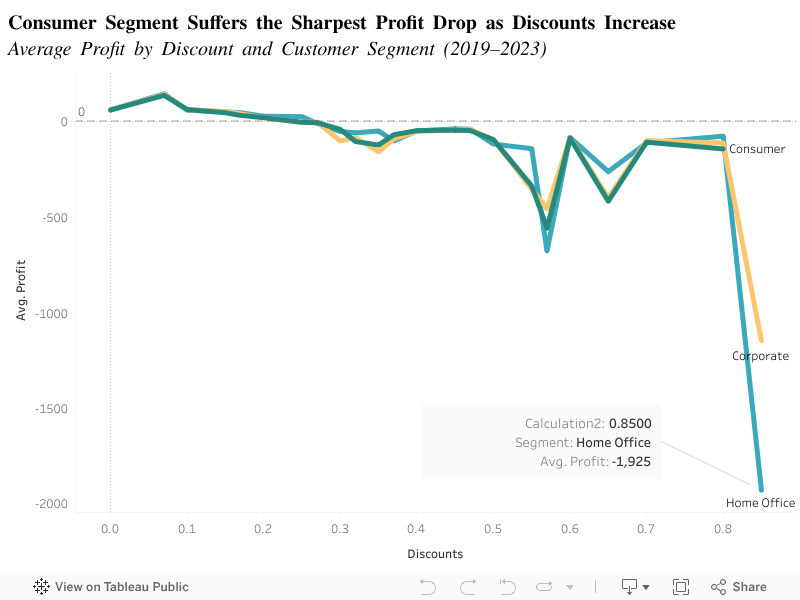
But our analysis of sales data from 2019–2023 shows a surprising pattern: as discounts grow, average profit can collapse; especially for the Home office segment.
Therefore, discount strategy needs to be segment-specific and evidence-based to avoid large financial losses.
-
-
Data: Sales transactions and profit per order, 2019–2023 (segmented: Consumer, Corporate, Home Office).
-
Question: How does average profit change as discount levels increase for each customer segment?
-
-
X axis: Discount level (0–85%).
-
Y axis: Average profit per order.
-
Each line = a customer segment (Consumer, Corporate, Home Office).
-
At low discounts the segments have stable profits. But past ~50% discount, profits decline. The Consumer line falls the fastest and deepest; at ~85% discount the Consumer segment reaches nearly –$2,000 average profit.
Insight: Deep discounts have a non-linear, highly negative impact on average profit for the Home office segment. Corporate and Consumer also decline but less steeply.
Home office often buy lower volumes and purchase lower-margin items; extreme discounts remove the margin buffer and flip the transaction into a loss. Corporate buyers may purchase higher volume or negotiate different terms that preserve margins.
-
Implications:
-
Avoid blanket deep discounts. Limit very large discounts for home office retail segments.
-
Segmented discount rules. Use smaller, controlled discounts for home office; allow negotiated or volume discounts for Corporate accounts where margins hold.
-
Test discount thresholds. Implement A/B tests and monitor profit by segment (use alerts when average profit crosses a risk threshold).
-
Revise loyalty incentives. Consider non-price incentives (bundles, loyalty points) for consumers rather than steep discounts. Discounts drive behavior, but beyond certain thresholds they destroy profit. A segment-aware pricing policy protects margins and keeps promotions profitable.

