
If I tell you that your signature may mean someone else makes a right choice, would you sign?
“Had I known it would be this way, I never would have chosen it”, “You’re lucky, you still have time, it’s too late for me”, “I wish I could also go back, I would’ve done it differently.”
Every time I told someone that I had quit my job and decided to change my career path completely, these sentences echoed around me. My coworkers, my friends, my superiors. They were all happy for me of course, but I remember being surprised at the amount of times I heard these sentences. Why is it that the news of my career change is met with envy and regret?
Over the next few months, this question stayed in the back of my mind, and eventually, my curiosity took the better of me. Is this regret widespread? Are people actually regretting their choice of career? If it’s the case, then why? And how can we prevent it?
Today, I answer all these questions. There is hope, but it won’t work without your help.
The broken promise
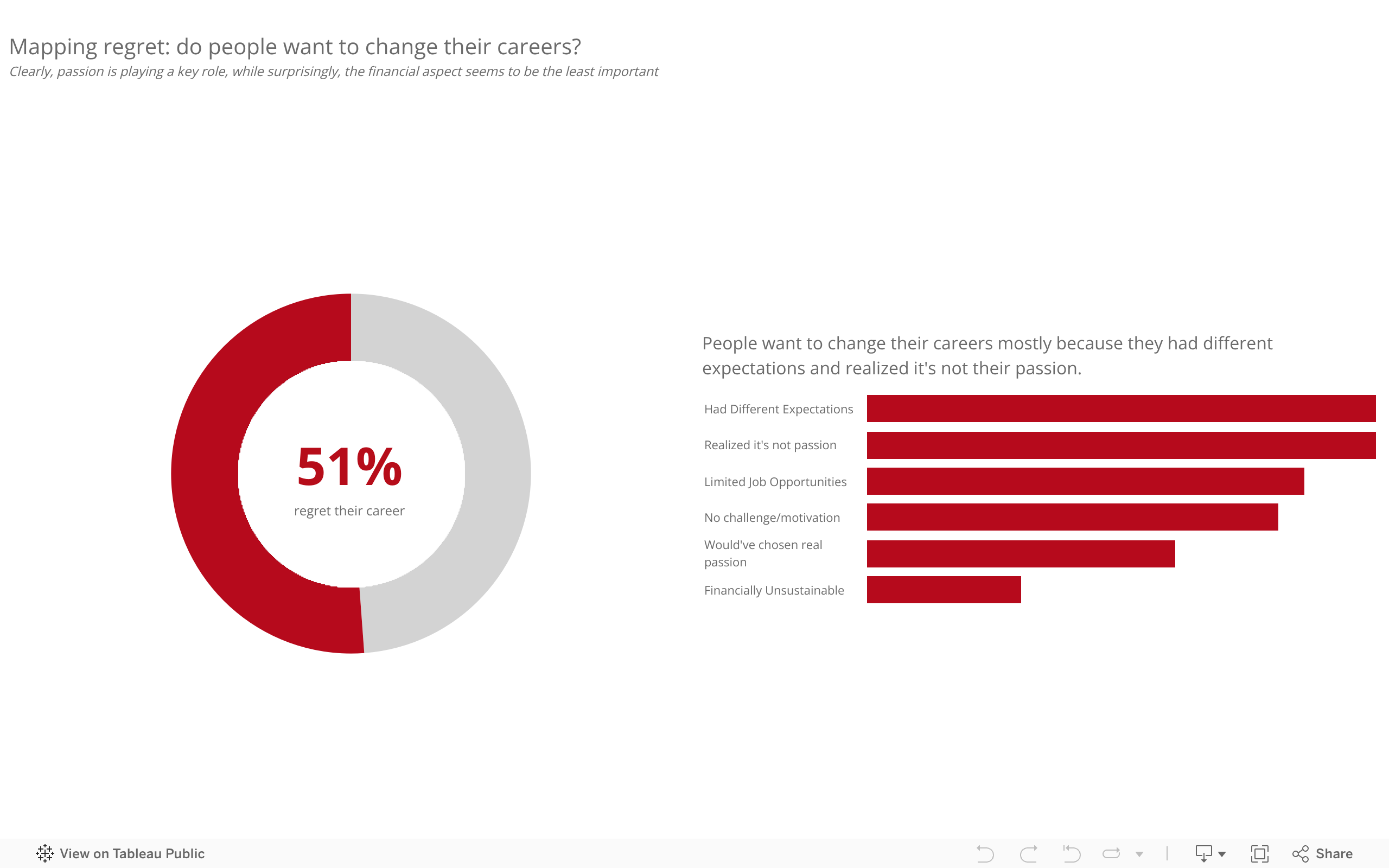
After studying Lebanese professionals, the numbers confirm it, career regret is indeed widespread. Today, 51% of Lebanese professionals report that, if they could go back, they would have chosen a different career. The solution seems too obvious right? Why don’t they just change if they’re not happy?
Unfortunately, it’s not as easy as it sounds. We’ve all heard the tales “don’t worry, if you don’t like it, you can still change”, “you still have time to decide, nothing is set in stone”, “it’s just a job, you’ll find a career you like eventually”. I believed it. I made my choice lightly and bet on the fact that, whatever happens, I will still have an exit strategy. But once push came to shove, every door I knocked at was closed. This is where you realize you’ve been fed a broken promise. No one warned us of the cost of that choice.
Change is not that easy, at least, not anymore.
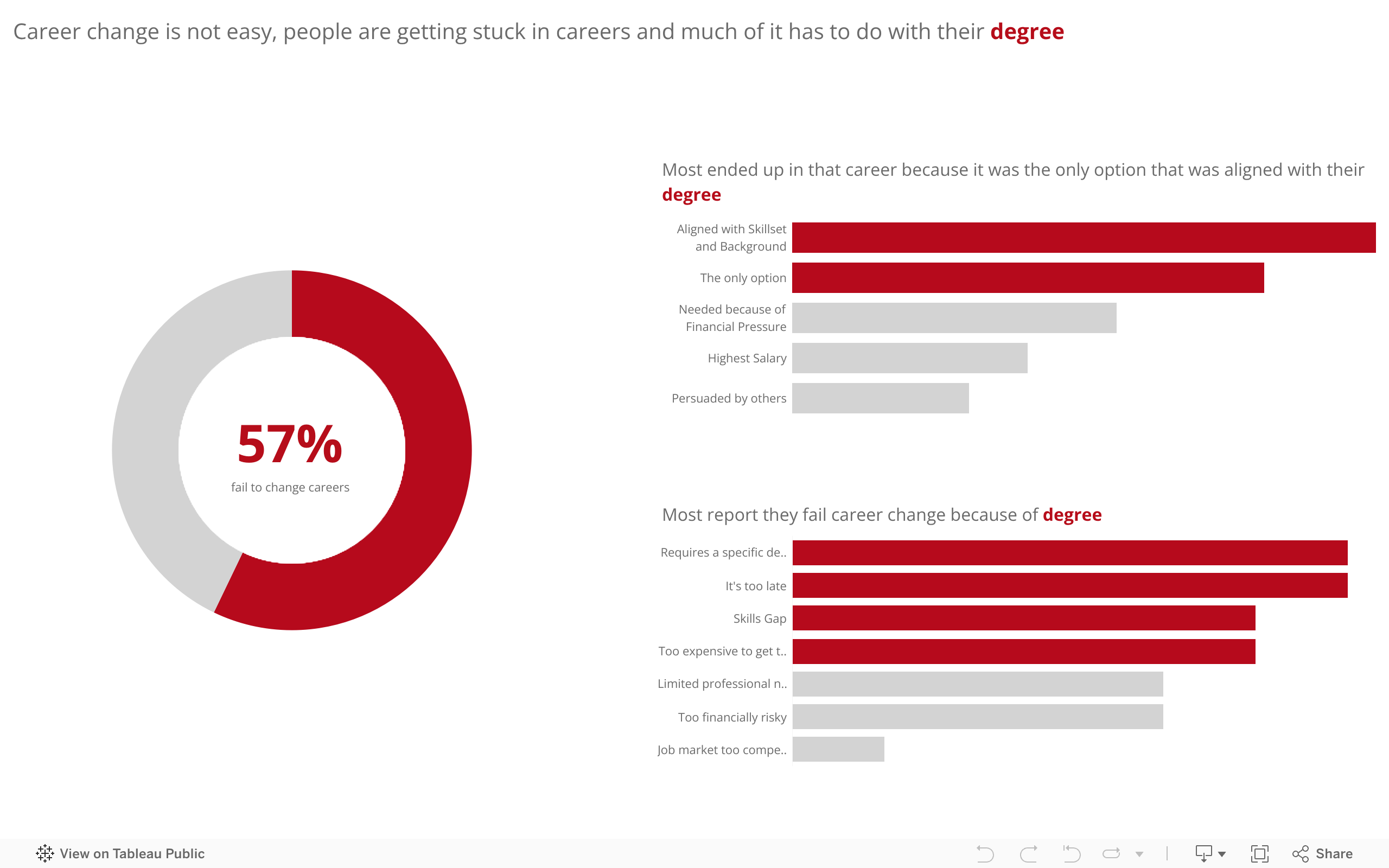
Today, as companies get more specialized, career mobility shrinks. Companies have extremely rigid and specific requirements in terms of experience and skills. They don’t only look at general experience and background anymore. They focus on very specific skills, and look for experience within the position that you’re being interviewed for. They will assess your skills to ensure you meet their requirements, investigate any gaps you may have and how long it will take them to get you up to speed. Competing within the job market is becoming much harder. Not having the right experience and skills, almost always means you won’t get the interview.
But how do we even end up in a certain career in the first place? What dictated the career paths that are available to us? Experience and skills are what companies look for. However, there’s one thing that happens way before then which will have a strong influence on the career paths you’ll have access to. That one thing, is your choice of degree.
I’m living proof of this. After realizing that the current career path I was on was not something I wanted, I tried to apply to other jobs that would put me on a different path. It was the same line over and over again, I either didn’t have the right experience or the right skills, or both. Today, I’m taking a masters’ degree to make that change, and I’m one of the lucky ones, those who can afford change, not everyone has that option. Fixing a wrong career choice is not only hard, it’s costly. I’m not alone in this, 60% of the people who were able to make a career change had to update their skillset.
That’s the cost of making the wrong choice. And it’s expensive.
The Problem
Therein lies the problem: In a world where career mobility is shrinking, and where degree has a decisive influence on career opportunities, we are asking students to make a choice that will have a huge impact on the path their professional lives will take, at only 17 years old. When I was 17, I didn’t even know certain careers even existed, didn’t even know what half of the university majors meant, but I was expected to know exactly what I wanted to do.
How do we address that? Preventing regret means choosing the right degree. But how do we make the right choice at such a young age? Are there factors that can enable better decision making?
The New Promise: Guidance Counseling


The power of guidance counseling lies in that it is the bridge between blind decisions and informed ones. It equips students with the facts before making their choice. That information is priceless.
The numbers are clear: in contrast to those who didn’t get counseling, those who did reported being more informed of the career opportunities tied to their degree and having career expectations that matched reality. These two factors are also directly linked to regret. This is not surprising. People chose their degree while being aware of where it will lead them and what they should expect from it, they choose it for exactly these reasons. In contrast, unmatched career expectations and opportunities leads to unpleasant surprises. Not being aware means expecting one thing and getting something completely different, something they did not necessarily choose, but got anyway. Because they unfortunately didn’t know, hence the regret. “This is not at all what I was expecting”, “I didn’t know this is how it would be like”, and the hardest of all “Had I known that before, I never would have chosen this”.
However, the story does not end here. Guidance counseling helps mitigate to career regret, but I was not content with stopping there. Something was not right. Guidance counseling is not a new concept and given its effect on career regret, why do we still have so much of it?
Keeping the promise: sign the petition
Regret still permeates because guidance counseling is the factor that is having the least influence in people’s degree decisions. Why? Is it an awareness issue? Do people not know of its positive effects? Or is it something even more systemic?
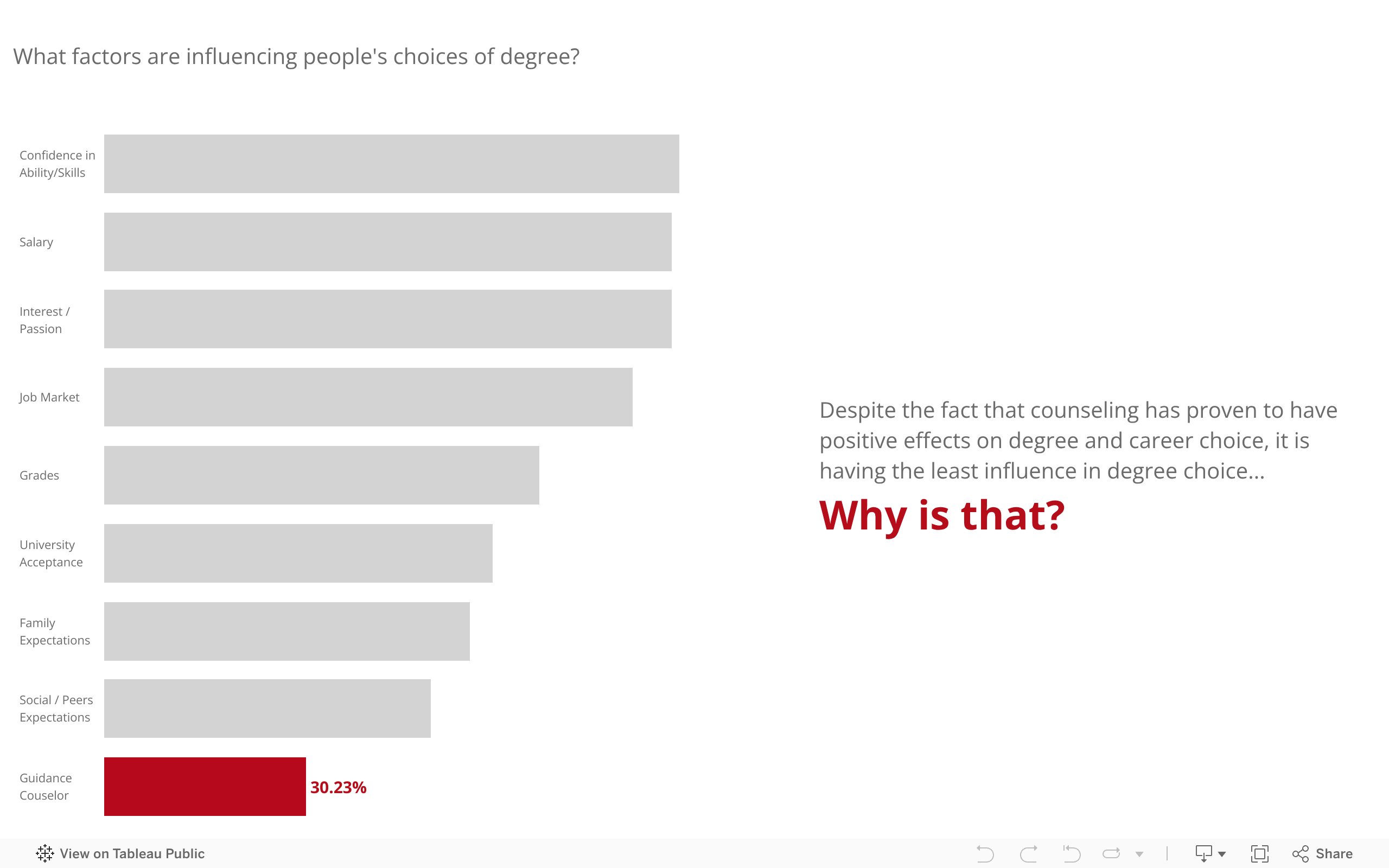
Why is it that something that is so helpful, something that bridges the gap between blindness and information, something that reduces regret, is not being leveraged? Why are we bypassing counseling?

Well, counseling is not having a major influence in people’s choice of degree simply because people are not getting counseling. More than 60% of people are not getting counseling. Why? Simple, it’s because it was never offered.
When we ask 17 years olds to make such a big decision, the least we could do is equip them with the right tools, the hard facts, and guidance counseling is the hard facts.
Today, this resource is just not available and it’s causing a great disservice to society. 51% of regret is something that cannot be ignored.
Someone has to act, and today, I’m asking you to.
I ask you again: if I tell you that your signature may mean someone else makes the right choice, would you sign?
For me, if that means that just one person ends up not regretting their choice, that’s already more than enough.
To make counseling systemic it needs to be passed into law: all schools must provide this service, and all students must attend to graduate. Guidance Counseling in every school and for every student. It’s the only way we ensure complete and total equal access to guidance counseling. I started a petition and I need your signature to make the government listen.
One signature may not seem like much but it carries a lot of meaning.
Your signature means you, your son, your daughter, your friend, won’t make a decision they’ll regret.
Your signature means someone thrives in their future.
Your signature means this article doesn’t need to exist anymore.
In short, your signature means breaking the cycle of regret.
Sign the petition.
Nice, i really like it
Joellegbousamra@gmail.com
Very interesting
Really interesting and knowledgeable
Very nice contribution
very interesting
Amazing topic!
Very interesting topic, good job 👏🏻
Very Interesting and Relatable!
Yes please we definitely need better guidance. Open doors are not helping much!
🙌🏻
Interesting
wow interesting read
Very interesting topic and great work!
Keep me posted
Nice work
Interesting!!
Fantastic
Nice work