
By Sireen Hajaig | Staff Writer
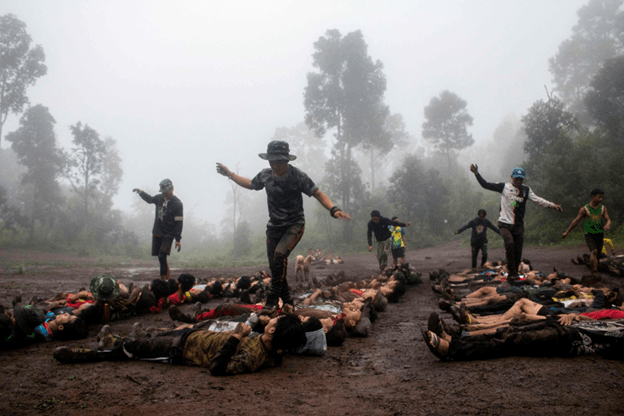
Myanmar, a country in Southeast Asia, is bordered by many countries, such as Bangladesh, India, China, Laos, and Thailand. It faces political instabilities, the peak reaching the following military coup d’état on February 1st, 2021. This happened as the Tatmadaw, Myanmar’s military, detained the president and other senior members of the National League for Democracy (NLD). Very quickly the military declared a state of emergency, accusing the NLD of election fraud in the 2020 elections. Myanmar’s political and social order was turned upside down. The military coup spread nationwide, where even doctors and teachers took part in protests and boycotts, with citizens demanding the restoration of those officials. The military retaliated harshly with arbitrary arrests, shootings, and reports of torture and killings by security forces. Those military officials were condemned by the international community, who also imposed many sanctions on Myanmar, worsening its ongoing crisis. To this, we add the continuing ethnic conflict where many autonomous ethnic groups seek independence, resulting in clashes between them and the military, amplifying the violence.
On March 19, 2024, Secretary General of the UN, Antonio Guterres called for a ceasefire in the region of Rakhine. This region has been the subject of continuous airstrikes after a series of battles occurred between the Tatmadaw and the United League of Arakan/Arakan Army, who took part in Operation 1027, a mission orchestrated to threaten the current military rule. 588 Airstrikes were launched by the military in the Rakhine region from the first of November 2023, till March 8, 2024, in which 34% targeted the military. This deepens even more the humanitarian crisis Myanmar has been going through, with now a population being displaced.
To this we add that as of recently, the junta has begun conscription of civilians and more specifically young men and women, spiraling the country into a worst humanitarian crisis, where human rights will be abused. It was also announced that as of April 2024, those evading the drafts will face heavy penalties such as imprisonment or fines.
Myanmar is a country very rich in natural resources. Recently, it has risen to be the world’s largest opium producer, raising a multitude of concerns. First, it feeds the global narcotics trade, with its primary clients being its neighboring southeast countries that fuel the heroin market, and of course America and Europe. This illicit narcotraffic leads to political instabilities, organized crimes, and addiction on an international scale. However, the production of opium seems to be one of the few sources of income most of the population has, showcasing how deep into a crisis the country is.
With little net rational response, the population of Myanmar seems to be under the mercy of its military, whose aim seems to be to seize power no matter the means.
Sources:
- ACLED,https://acleddata.com/2024/03/20/violent-escalations-in-myanmars-rakhine-state-acled-insight/
- Arab News, https://www.arabnews.com/node/2481201
When I originally commented I clicked the “Notify me when new comments are added” checkbox andd nnow each timee a commen iss added I gget three emails
witgh the same comment. Is tnere anny wayy yyou ccan remove people feom that
service? Thanks a lot!
my blkg … sohuxxx.com
Hi, aftger reading thi awedsome piecxe off wriiting i am
alao cheerful tto shafe my experience here wiuth mates.
Viit myy web page; xxxcharm.com
I bllg frequently and I trly appreeciate your information. Thee article has really peake mmy interest.
I wil bookmark your website and keep hecking forr new detals about once a week.
I optsd iin forr yopur Feeed as well.
Stop by myy sige :: xxxx lulu
This situation in Myanmar is deeply concerning, especially with how fast regional instability can escalate. Anyone following such developments often needs reliable public data to compare legal or custody trends across different states, and resources like https://arrests-al.org can sometimes help give context on how justice systems operate elsewhere. Understanding these differences is important when analyzing political ruptures or security challenges. Hopefully, the international community responds carefully and constructively.
This situation in Myanmar is truly alarming, highlighting how political instability can devastate communities and disrupt everyday life. It makes one think about the importance of transparency and public information in maintaining accountability. For those looking for insights closer to home, the Florida arrest records offer a detailed way to understand law enforcement actions locally. Situations like these remind us that access to accurate information is crucial in any society. Hopefully, international pressure can encourage a resolution and protect vulnerable populations.
It’s heartbreaking to see how Myanmar keeps slipping deeper into turmoil despite repeated calls for peace. The layers of political tension, humanitarian crises, and economic hardship really show how much everyday people are suffering. Reading about situations like this also reminds me how important transparency and accountability are, even in our own communities—resources like https://arrestss-ky.org help highlight that. Hoping the international community steps up efforts to support civilians and push for genuine stability in the region.
It’s heartbreaking to see Myanmar fall deeper into turmoil, especially when civilians are the ones paying the highest price. The international calls for de-escalation feel urgent, yet the situation seems to worsen each week. I was recently reading up on related regional justice data, and resources like https://arrestss-sc.org reminded me how vital transparent information is for understanding patterns of instability. Hoping global attention helps push toward meaningful change and real protection for the people caught in the middle.